
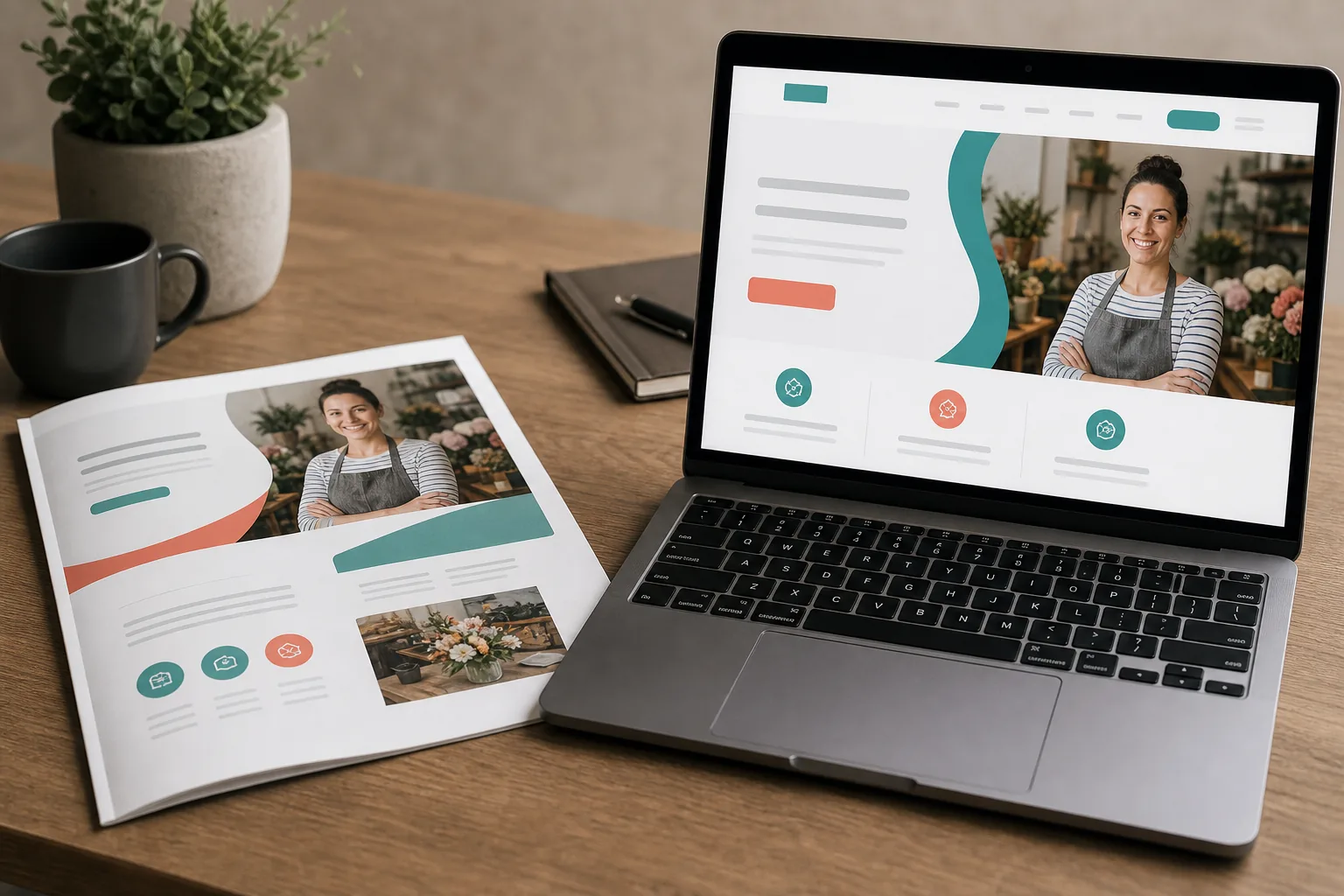
Small business owners in Ahmedabad, Surat and across Gujarat ask us daily: brochure or landing page — where should I invest first? The answer in 2026 is almost always both — but for different moments in the buyer journey. Print collateral builds credibility at trade fairs, distributor meetings and retail counters where a digital link goes nowhere. A well-built landing page captures Google search traffic, paid ad clicks and WhatsApp link taps that a printed brochure cannot reach. Understanding which tool wins at which touchpoint — and how to connect them — is exactly what this guide covers.
Brochure vs landing page: full comparison for Gujarat SMBs
| Use case | Brochure / print | Landing page |
|---|---|---|
| GMDC trade fair / SG Highway exhibition | Strong — physical takeaway, memorable | Weak without QR code linking to it |
| Retail counter & showroom | Strong — answers questions without staff | Medium — works when you hand a phone |
| Google Ads & Meta paid campaigns | Weak — no digital CTA | Strong — conversion-optimised, trackable |
| WhatsApp catalog link | Weak — PDFs rarely opened | Strong — mobile-fast, WhatsApp CTA button |
| Update pricing or offers | Slow — requires reprint | Fast — live edit in minutes |
| Gujarat B2B distributor pitch | High trust — distributors expect print | Medium — feels informal without supporting print |
| Navratri / Diwali sale campaign | Medium — printing lead-time is a constraint | Strong — launch same day, share via Status & ads |
| Analytics & ROI tracking | Impossible directly | Full tracking — clicks, leads, conversions |
| 2026 best practice | Use both — same brand system + QR codes linking print to mobile landing pages | |
When a brochure still wins in 2026
Reports of print's death are exaggerated — especially in Gujarat's trade and distribution culture. Here are the situations where a well-designed brochure consistently outperforms digital-only marketing:
Trade shows and business exhibitions
Ahmedabad's GMDC Grounds host Gujarat's largest trade exhibitions — Vibrant Gujarat summits, textile and MSME fairs, buyer-seller meets and Agri expos. At these events, a distributor from Rajkot or a buyer from Vadodara walks your stall and leaves with a bag of brochures. A well-designed A4 or trifold with product specs, pricing tiers and a WhatsApp QR code stays in front of that buyer for days. A URL they cannot remember does not. The same logic applies to SG Highway retail shows, Surat's Diamond and Textile exchanges, and regional B2B events across the state.
Retail counters and showrooms
Jewellery showrooms on CG Road, furniture stores in Satellite, ethnic wear boutiques in Law Garden — customers browse before they buy. A counter card or product brochure answers questions when your floor staff is occupied: material specifications, stone certifications, care instructions, price ranges and delivery options. Leave it at the counter and it works for you every hour the store is open.
B2B and distributor meetings
Gujarat's trading culture — particularly for manufacturers in Odhav, Naroda and Vatva pitching to pan-India distributors — expects printed collateral. Arriving at a meeting with a laminated product catalogue and company profile signals investment and professionalism. A shared screen or PDF feels casual; a printed booklet with MOQ tables, factory photos and certifications signals you are ready to do business at scale.
High-trust categories and senior buyers
For healthcare, real estate, professional education and financial services where buyers take weeks to decide, a brochure that includes your address, credentials, client logos and testimonials builds long-term trust that a digital ad impression simply cannot replicate. Senior buyers in these segments often specifically ask for printed material to share with family or colleagues before committing.
When a landing page wins
For every moment where print shines, there are equally important situations where a targeted landing page dramatically outperforms any brochure:
Google Search and paid traffic
When someone searches "jewellery shop Ahmedabad" or "wedding catering Gujarat" and clicks your Google Ad or organic result, they land on a webpage — not a PDF. A landing page with fast load speed, a clear headline, social proof and a prominent WhatsApp CTA button converts that search intent into a lead. Studies consistently show dedicated landing pages convert paid traffic 2–5× better than generic homepages. For any Ahmedabad or Gujarat business running Google Ads or Meta performance campaigns, a dedicated landing page per offer is non-negotiable.
WhatsApp Status links and influencer traffic
Gujarat's social commerce runs on WhatsApp. When you share a link via WhatsApp Status, a broadcast list or an influencer's bio, it goes to a mobile URL that needs to load in under 2 seconds. A fast, mobile-first landing page with a clear "Order on WhatsApp" CTA converts those taps into conversations. A PDF attachment takes 30+ seconds to download and most users never open it.
Dynamic pricing, time-limited offers and festive campaigns
A brochure printed in October is useless when you need to update a Diwali discount price on November 2nd. A landing page is edited live in minutes — change the price, add a countdown timer, swap the offer headline. For Gujarat businesses running seasonal sales (Navratri, Diwali, Akshaya Tritiya, Eid, wedding season January–April), this flexibility can mean the difference between a campaign that works and one that's outdated by launch day.
Analytics, remarketing and A/B testing
Every click, scroll and conversion on a landing page is measurable. You can run Google Analytics, Meta Pixel and WhatsApp click tracking simultaneously. You cannot track who read your brochure. For data-driven Ahmedabad businesses investing in digital marketing, landing pages are the only way to know what creative, offer or headline actually drives inquiries.
The hybrid approach: print + digital working together
The highest-performing marketing system for Gujarat SMBs in 2026 does not choose print over digital or vice versa — it connects both through a consistent brand system:
Same visual identity across every channel
Your brochure, visiting card, landing page and Instagram profile should share the same logo, colour palette, fonts, photography style and tone of voice. When a distributor sees your brochure at a Surat trade fair and later searches you online, instant visual consistency builds confidence. Mismatched design between print and digital is one of the most common trust killers in Gujarat's SMB market.
QR codes that link print to conversion
Every printed piece — brochure, visiting card, menu, standee, packaging insert — should carry a QR code that links to a specific mobile landing page. Not your homepage; a page designed to receive that exact visitor with a relevant offer and a WhatsApp CTA. This also lets you track exactly how many leads your physical collateral is driving — something most Ahmedabad businesses have never been able to measure before.
One brand story, multiple formats
For a Navratri ethnic wear launch: print trifold distributed at showroom → QR links to Navratri collection page → visitor taps WhatsApp CTA → sale closes on chat. The brochure builds trust; the landing page handles the conversion; WhatsApp closes the deal. This pipeline only works when all three share the same design language — something Tegvo builds as a single integrated brief.
Brochure & print design for Ahmedabad & Gujarat businesses
Gujarat's business culture has specific print requirements that generic templates miss:
- Trade fairs (GMDC, SG Highway, textile expos): A4 single-fold or trifold brochures with product specs, price tiers and WhatsApp QR are the standard takeaway. Leave space for a business card to be stapled — buyers still pin these to their office boards.
- Retail launches (CG Road, Maninagar, Law Garden): Counter cards, in-store product sheets and loyalty insert cards work at high-footfall retail counters in Ahmedabad's most active commercial zones.
- Distributor meetings (Surat, Vadodara, Rajkot): Company profile brochures (A5 booklet or saddle-stitch catalogue) with certifications, product line overview and MOQ tables match exactly what pan-Gujarat distributors expect to receive at B2B meetings.
- Visiting cards: Still taken seriously at every business meeting in Gujarat. Premium card stock, clean design, WhatsApp number and a QR code linking to your WhatsApp profile or portfolio are the 2026 standard.
- Export-oriented businesses (GIFT City, CG Road offices): Bilingual brochures (English + Gujarati or Hindi) for domestic distributors alongside English export-spec catalogues for international buyers.
Searches like "brochure design Ahmedabad", "visiting card design Gujarat", "company profile design Surat", "print-ready catalogue India" and "graphic design agency Ahmedabad" reflect exactly what business owners need — professional print collateral that matches their digital identity. Tegvo delivers print-ready PDFs, visiting card designs and matching digital assets within 3–5 business days from brief approval.
Get a quote for your brochure, visiting card or landing page
Contact Tegvo → View our design portfolio →Tegvo design deliverables for Ahmedabad & Gujarat brands
We design print and digital assets from a single brief so your brochure and landing page always look like they belong together — which is exactly what builds trust across both channels:
- Brochures: A4 single-fold, A5 trifold, Z-fold, DL flyers and multi-page catalogues — delivered as print-ready PDFs with bleed, CMYK colour profiles and printer-ready specs.
- Visiting cards: Standard 90×54mm, folded, premium-finish and die-cut designs. Supplied as vector files compatible with Ahmedabad and Gujarat print shops.
- Company profiles: 8–24 page product or service brochures designed for B2B presentations, tender submissions and distributor pitches.
- Landing pages: Fast-loading, mobile-first pages with WhatsApp CTA, Google Analytics integration and conversion tracking — see our website development service.
- Social assets: Matching Instagram posts, Reels thumbnails, stories and WhatsApp Status graphics — so your brand looks consistent everywhere a customer sees it.
Every project includes a minimum of two structured revision rounds and a cross-channel consistency check before delivery.
Frequently Asked Questions
What file formats do you deliver for print brochures?
We deliver print-ready PDFs with 3mm bleed on all sides, CMYK colour mode, and embedded fonts — compatible with commercial offset printers across Ahmedabad, Surat and Gujarat. We can also provide layered InDesign or Illustrator source files on request.
Can you match my existing logo and brand colours?
Yes — send us your logo (preferably vector AI or EPS, or a high-resolution PNG) and any existing brand guidelines. We match colours using exact CMYK or Pantone references. If you only have a low-resolution JPG logo, we can trace and vectorise it as part of the project.
What is the typical turnaround for a brochure design in Ahmedabad?
Most brochure projects complete in 3–5 business days from brief approval, including two revision rounds. Rush delivery in 1–2 days is available for time-sensitive trade fair or launch deadlines. Landing pages typically take 5–7 days depending on content complexity.
Should my visiting card have a QR code in 2026?
Yes — a QR code linking to your WhatsApp, portfolio or a specific landing page is now standard on business cards for Ahmedabad and Gujarat professionals. It turns a passive contact card into an active lead generation tool. We include a custom QR code in every visiting card design at no extra charge.
Do you design matching landing pages alongside brochures?
Absolutely — we recommend designing both from the same brief so they share the same visual identity, messaging and colour palette. Brand consistency between print and digital is what converts a trade fair visitor who took your brochure into a WhatsApp inquiry when they search for you online days later.
Can you design brochures in Gujarati or Hindi for regional markets?
Yes — we design bilingual brochures (English + Gujarati or English + Hindi) for markets where local language builds greater trust, such as rural Gujarat distribution networks, semi-urban retail chains and B2B meetings with regional buyers who prefer their native language for technical specifications.
