
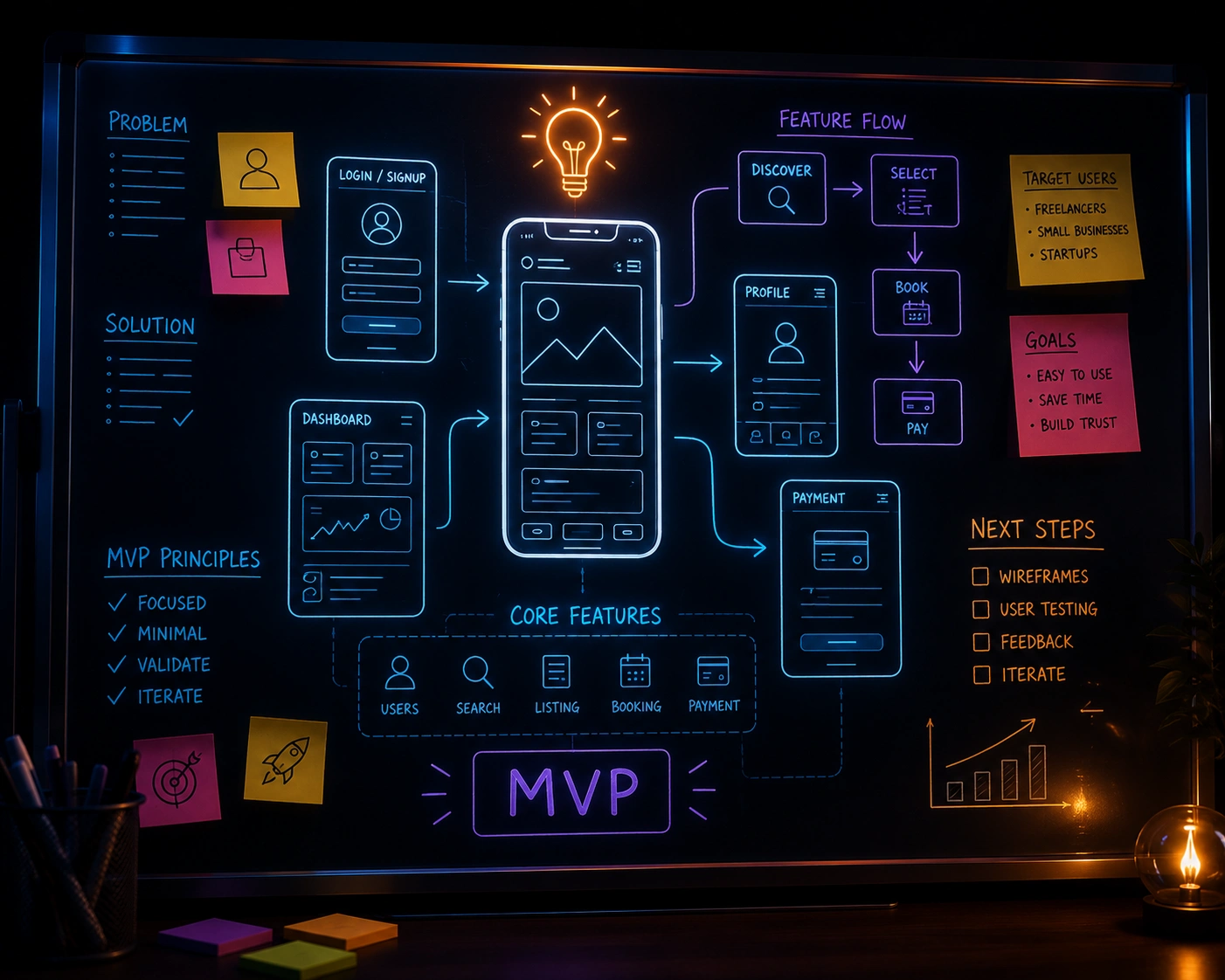
Most Indian startup founders who come to Tegvo wanting to build an app arrive with a long feature list and no clarity on which features are essential. This is the single most expensive mistake in MVP app development India startups make — building too much before validating that anyone wants the core thing. This guide covers how to plan a proper MVP before approaching a developer or agency, so you build the right version first.
What MVP Actually Means — and What It Doesn't
MVP stands for Minimum Viable Product. "Minimum" means the smallest version that can be used by real customers. "Viable" means it must actually work and provide real value — not a broken prototype, not a demo with dummy data. "Product" means it's something users can interact with to produce a real outcome.
What an MVP is not: a half-finished version of your ideal app, an app missing half its features because the budget ran out, or a version so stripped back that real users can't complete any meaningful workflow. An MVP should do one thing excellently — the core thing — and defer everything else to version 2 after the core is validated.
Step 1 — Define Your Core Hypothesis
Before writing a single screen brief or approaching a developer, write this sentence: "I believe [user type] will [do this core action] to solve [this specific problem]."
For a service booking startup: "I believe home service customers in Ahmedabad will book plumbing appointments through an app to avoid the uncertainty of calling individual plumbers."
For a D2C ordering tool: "I believe independent kiranas in Gujarat will use an app to place wholesale orders with distributors to eliminate the need for distributor sales rep visits."
Every feature that directly tests this hypothesis belongs in your MVP. Every feature that doesn't test it belongs in version 2. Run your full feature wishlist through this filter — most lists shrink by 40–60%.
Step 2 — Scope Your Screens, Not Your Features
A more useful way to define MVP scope for developers is by listing screens rather than features. Features are vague ("booking system", "user profiles"); screens are concrete ("booking confirmation screen showing appointment date, provider name and cancel option"). Developers quote accurately from screen lists because each screen translates to a definite amount of work.
A typical service marketplace MVP — one of the most common startup app types in India — covers roughly 12–16 screens:
- Onboarding / splash (1–2 screens)
- Registration and OTP login (2–3 screens)
- Home / browse (1–2 screens)
- Service or provider listing (1 screen)
- Service detail and booking form (2 screens)
- Payment screen (1 screen)
- Booking confirmation and status (1–2 screens)
- Order history / bookings list (1 screen)
- User profile and settings (1–2 screens)
If your MVP requires more than 20 screens, it is almost certainly over-scoped. The vendor or admin dashboards alone often add 5–10 screens — consider deferring these to a web dashboard rather than building them into the mobile MVP.
MVP vs Full Build — What Changes
| Factor | MVP Build | Full Product Build |
|---|---|---|
| Screens | 5–15 core screens | 30–80+ screens |
| Cost (India) | ₹2,00,000–₹8,00,000 | ₹10,00,000–₹30,00,000+ |
| Timeline | 8–16 weeks | 4–9 months |
| Admin dashboard | Minimal or deferred | Full dashboard included |
| User roles | 1–2 (customer + maybe provider) | 3+ with role-based access |
| Analytics | Firebase basic events | Custom analytics dashboard |
| Scalability | Handles early user volume | Architected for scale |
Chat with Tegvo on WhatsApp — describe your idea and we'll help you identify the minimum scope worth building first.
Step 3 — Wireframe Before You Approach Developers
Approaching developers with "I want an app like Zomato but for X" produces wildly varying quotes based on each developer's interpretation of scope. Approaching developers with a 12-screen wireframe showing exactly what each screen contains produces accurate, comparable quotes.
Wireframes do not need to be beautiful — hand-drawn sketches or low-fidelity Figma frames are sufficient for this stage. The purpose is to answer these questions for every screen: What information is displayed here? What actions can the user take? What happens when they tap each element? Answering these questions yourself before development begins saves enormous time and money in the build phase.
Step 4 — Platform and Tech Choices for Your MVP
Start with Android only for your India MVP. Android runs on over 85% of Indian smartphones, and launching on Android first means your early users are reachable at lower development cost than a simultaneous Android + iOS launch. Add iOS in version 2 after you've validated the product on Android with real users.
For the technology choice, Flutter (cross-platform) is the practical recommendation for most Indian startup MVPs in 2026. It produces high-quality Android and iOS apps from a single codebase, has a large developer talent pool in India, and is actively maintained by Google. React Native is the alternative — both are viable; Flutter tends to have better performance and widget consistency. Native Android-only (Kotlin) is appropriate if you genuinely only need Android now and want maximum platform performance.
Step 5 — Lock Scope and Resist Changes Mid-Build
Once your screen list is agreed and development has started, any new feature request must be evaluated against a clear test: does this feature need to be in version 1 to prove the core hypothesis? If no — log it in the version 2 backlog and do not add it to the current build. Mid-build additions are 2–3× more expensive than planning them upfront because they require changes to work already completed and extend timelines unpredictably.
This is the hardest discipline in MVP development for first-time founders — the temptation to add one more thing is constant. A written scope document signed by both parties is the practical solution. Anything not in the signed scope document is a change order, not a "quick addition."
Frequently Asked Questions
What is an MVP app and why should Indian startups build one?
An MVP (Minimum Viable Product) app is the smallest version of your product that real customers can use to test your core hypothesis. Indian startups should build MVPs because they cost significantly less (₹2L–₹8L vs ₹10L+), launch faster (8–16 weeks vs 4–9 months), and reveal whether customers actually want the product before you invest in the full build.
How do I define what goes in my app MVP?
Write your core hypothesis: "I believe [user type] will [do this action] to solve [this problem]." Every feature that directly tests this hypothesis belongs in the MVP. Every feature that doesn't test it belongs in version 2. Run your full feature wishlist through this filter — most lists shrink by 40–60% when filtered this way.
How many screens should an MVP app have?
Most well-scoped MVPs have 5–15 screens. If your MVP has more than 20 screens, it is likely over-scoped. A service marketplace MVP typically needs about 12–16 screens covering onboarding, login, browse, detail, booking, payment, confirmation and profile. Admin dashboards should be deferred or built as a separate web interface.
Should I design the app before finding a developer?
Yes — having wireframes before approaching developers produces accurate, comparable quotes; forces scope clarity; and significantly reduces miscommunication during development. Basic hand-drawn sketches or low-fidelity Figma frames are sufficient. Good agencies include UX scoping as the first phase before writing any code.
What is the biggest mistake Indian startups make when planning an app MVP?
Scope creep during development — adding features mid-build. Every addition costs more than if planned upfront, extends timelines, and shifts developer focus from core functionality. The second most common mistake is building for both Android and iOS from day one. Start with Android (85%+ of Indian smartphone users), validate, then add iOS in version 2.
How do I choose between a freelancer and agency for my MVP in India?
For MVPs under ₹3,00,000 with simple, clear scope, a vetted freelancer can deliver well at lower cost. For MVPs with payment integrations, multiple user roles, or backend complexity, a small agency is safer — design, development and QA under one contract. Always check 2–3 references from previous clients before signing with any development partner.
