
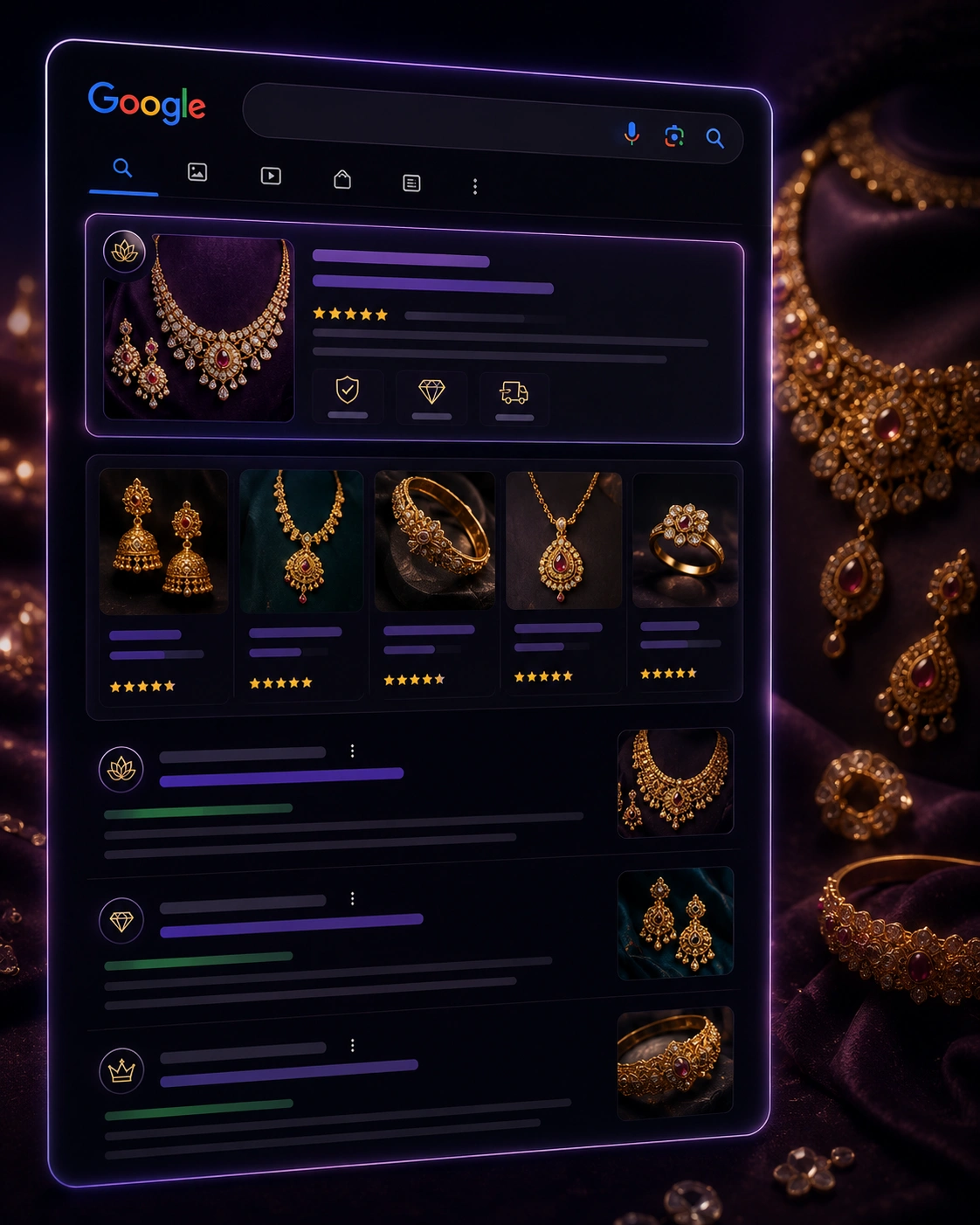
Indian jewellery and fashion brands face a specific challenge with SEO: extremely high competition on broad keywords ('gold earrings online', 'sarees India') dominated by large marketplaces like Myntra, Nykaa Fashion, and Tanishq, combined with a massive opportunity in long-tail product keywords that these large players systematically underserve. SEO for a jewellery website is not about competing with Tanishq on 'gold earrings' — it is about capturing the thousands of specific, high-intent searches that large catalogues dilute and that a focused brand can win.
Product Page SEO — The Foundation
Most Indian jewellery brands have product pages with generic titles ("Gold Earrings - Product 124") and no unique descriptions. This is the largest SEO gap in the category. Every product page should have:
- Unique title tag with specific keywords: "22-Carat Gold Jhumka Earrings — Rajasthani Meenakari Design | YourBrandName" rather than "Gold Earrings | Product 124".
- Unique meta description: 120–155 characters with material, weight (if relevant), occasion, and style details. "Traditional 22-carat gold jhumka earrings with meenakari enamel work, 8 grams, ideal for bridal and festive occasions. Ships across India."
- Unique product description: At least 150 words covering material, making technique, occasion suitability, care instructions, and design inspiration. Not a copy of the manufacturer description or a duplicate of another product page.
- Structured data (Product schema): Name, image, description, price, availability, and brand — helps Google display rich results in search including price and availability.
Google Image Search — The Underutilised Channel
Jewellery is one of the categories where Google Image Search drives genuine purchase intent. A buyer searching "kundan maang tikka bridal" in Google Images is in active discovery mode — if your product appears and links to a well-optimised product page, that is a high-conversion visit. Most Indian jewellery brands have filenames like "IMG_4521.jpg" and blank alt text, giving up this entire channel.
Image SEO checklist for jewellery products: descriptive filename with keywords before the shoot ("gold-jhumka-22-carat-rajasthani-design.webp"), specific alt text describing the piece in buying terms, WebP format compressed to under 200KB, multiple images per product (front view, worn view, detail close-up — each with unique alt text), and submission of a product image sitemap to Google Search Console.
Keyword Strategy for Indian Jewellery and Fashion Brands
| Keyword Tier | Example | Target On | Competition |
|---|---|---|---|
| Broad category | "gold earrings online India" | Category page | Very high — Myntra, Tanishq |
| Specific product | "22-carat gold jhumka meenakari" | Product page | Low — winnable |
| Occasion keywords | "bridal jewellery set for south Indian wedding" | Blog / collection page | Moderate |
| Local keywords | "jewellery shop Jaipur gold" | GBP + About/Contact page | Low for specific city |
| Question/guide | "what jewellery to wear with lehenga" | Blog post | Low — discovery traffic |
Chat with Tegvo on WhatsApp — we specialise in SEO for Indian product brands and ecommerce.
Frequently Asked Questions
What are the most important SEO factors for a jewellery website in India?
Product page SEO (unique titles with specific keywords, unique descriptions, product schema), Google Image Search optimisation (descriptive filenames, specific alt text, WebP format), category page SEO for broader keywords, and local SEO with Google Business Profile for physical stores.
How does SEO for a fashion website differ from SEO for other businesses?
High image volume requires systematic image optimisation; seasonal content (Navratri, Diwali, bridal season) must be published ahead of peak search periods; broad keywords are dominated by large marketplaces, so fashion brands win on specific long-tail keywords or local terms.
What keywords should a jewellery brand target for SEO in India?
Long-tail product keywords with buying intent (e.g. "22-carat gold jhumka earrings buy online"), category keywords on category pages, occasion keywords on collection or blog pages (e.g. "bridal jewellery south Indian wedding"), and local keywords if you have a physical store.
Does a jewellery brand need a blog for SEO?
A blog significantly accelerates SEO results and captures discovery traffic that product/category pages cannot. Content like "how to choose bridal jewellery", "what jewellery to wear with a lehenga" or "difference between gold and gold-plated" gets consistent search volume and reaches buyers in active research mode.
How do I optimise product images for a jewellery website?
Descriptive filenames (not img_001.jpg), specific alt text describing the piece in buying terms, WebP format compressed to under 200KB, multiple angles per product each with unique alt text, and submit a product image sitemap to Google Search Console.
How long does SEO take for a new jewellery website in India?
1–3 months for indexing; 3–6 months to rank for long-tail product keywords; 6–12 months for meaningful category keyword rankings. Local keywords for a physical store can rank within 2–3 months with a verified Google Business Profile.
