
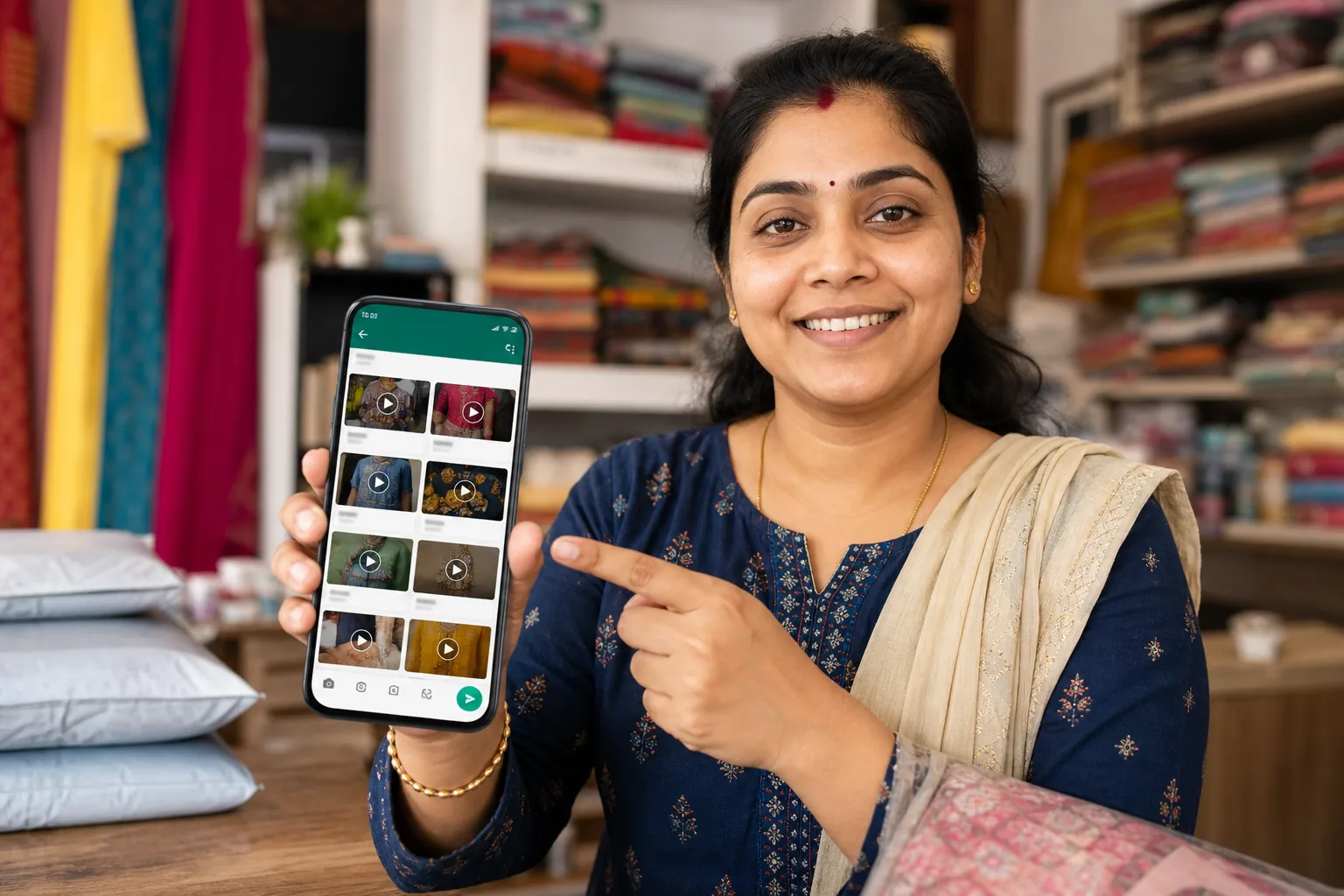
In India — especially in Gujarat, where Ahmedabad jewellers, Surat textile traders and Vadodara D2C brands run significant portions of their business entirely on WhatsApp — customers have moved well beyond expecting only product photos. They expect short product videos in catalog messages, WhatsApp Status updates and broadcast lists that show motion, texture, scale and trust in 15–30 seconds. If you are still sending only static JPEGs and PDF catalogs, you are losing orders to sellers who demonstrate the same product through video before the customer even asks a question.
Why video catalogs outperform photo grids on WhatsApp
WhatsApp video conversion is higher than photo conversion across every product category in India for concrete reasons — not just because video is trendy:
- Video shows what photos cannot: Jewellery sparkles and catches light dynamically. Fabric drapes and moves, showing how it falls on a body. Food looks fresh when you see steam and texture. A kitchen appliance demonstrates its function in 10 seconds. Static photos communicate none of these purchase-relevant qualities.
- Video is forwarded — photos are saved and forgotten: An engaging 20-second product reel gets forwarded from the buyer's WhatsApp to family members, friends shopping for similar items or colleagues looking for the same category. Photo catalogs rarely get forwarded organically. Every forward is a free sales impression.
- Video builds pre-purchase trust: When a buyer can see the product moving, the model wearing it and the packaging before they pay, their hesitation to buy without physically handling the product decreases significantly. This is especially important in Gujarat's WhatsApp commerce where buyers often purchase from sellers they have never met in person.
- Video earns faster replies: A status reel of jewellery gets "price?" and "what's the weight?" messages within 20 minutes of posting. A JPEG catalog gets those same messages 4–6 hours later, if at all, because most contacts scroll past static grids during the working day.
Build your complete WhatsApp video stack
A systematic WhatsApp video catalog is not a single reel — it is a stack of different video types that serve different roles in the buyer journey. Here is the complete stack for fashion, jewellery, food and D2C brands:
1. Hero collection reel (30–45 seconds)
One reel per collection launch — festive, bridal, new arrival or sale drop. Shows 3–6 hero products or looks in sequence, set to relevant music, with your brand name in the first frame and a "DM to Order" CTA at the end. This is your launch announcement and the reel you share with your broadcast list first. Post it to WhatsApp Status at 8–9 AM to maximise the morning browse window.
2. SKU product clips (8–15 seconds)
Individual short clips for each key SKU — showing the product from multiple angles with a price overlay in the final 2 seconds. These are the catalog tiles that replace JPEG images in your catalog messages. When a customer asks "what do you have for Navratri?" you send them 4–6 product clips in sequence rather than a photo grid — each clip shows the product better than any photo, and the customer can immediately respond with "I want the third one."
3. Social proof / dispatch clips (15–20 seconds)
Short clips showing real orders being packed, dispatched or received. A 15-second clip of a jewellery piece being wrapped in tissue, sealed in a branded box and labelled for dispatch builds more purchase trust than any written testimonial. Add a text overlay: "Dispatched Today — Order Now for Delivery by Friday." These clips reduce the #1 hesitation in WhatsApp commerce: "Will the product actually arrive? Is this genuine?"
4. Offer and deadline reels (15 seconds)
Campaign-specific clips for sale windows — price display, countdown to deadline, "Only 3 Left" inventory urgency. Keep these brief, direct and CTA-forward: product visual, price, deadline, "DM ORDER or WhatsApp [number]." These are paid ad material as well as Status posts. Brief the offer details before production so the text overlays are accurate at launch.
5. Customer/buyer review clips (15–20 seconds)
With buyer permission, compile a short 15-second montage of customer unboxing reactions, WhatsApp review screenshots (animated) or before/after use results. Add your brand name and "Join [X] Happy Customers" overlay. Social proof content consistently drives the highest purchase conversion on WhatsApp because it demonstrates that other real people have already trusted the seller — which is the core trust question in any WhatsApp sale.
WhatsApp commerce in Ahmedabad, Surat & Gujarat
Gujarat's commerce culture has adapted to WhatsApp more thoroughly and earlier than most other Indian states. Several specific dynamics define how WhatsApp selling works here:
- Surat's textile lanes: Surat's Diamond and Textile trading ecosystem runs significantly on WhatsApp — traders send fabric videos to retail buyers, design houses share seasonal collections via Status, and B2B saree deals close on WhatsApp chat before an invoice is ever raised. Video catalog quality directly determines which supplier a buyer orders from when all other factors are equal.
- Ahmedabad jewellery market: CG Road, Maninagar and Satellite jewellery retailers as well as manufacturers in the wholesale jewellery district use WhatsApp to share new designs with existing customers the same day they arrive. A video clip that shows the shine and craftsmanship of a new necklace converts significantly faster than a photograph.
- Wholesale fashion markets: Ahmedabad's Laldarwaza and Manek Chowk wholesale fashion corridors serve retailers across Gujarat. Bulk buyers from Rajkot, Vadodara and smaller towns increasingly place orders via WhatsApp video catalog without visiting in person — a complete shift from the pre-2020 market structure.
- Women's self-help groups and resellers: Gujarat has a large and active network of women resellers operating via WhatsApp — selling sarees, ethnic wear, jewellery and home products to their social networks. High-quality product video clips help these resellers compete with more established accounts and increase their own conversion rates.
AI video for weekly catalog refreshes — the competitive edge
Traditional product shoots happen once per season — meaning your catalog is fresh for 2–4 weeks after the shoot and stale for the remaining 10–14 weeks of the quarter. WhatsApp buyers expect new content regularly: every Navratri night is a different purchase opportunity, every payday weekend drives discovery, every major cricket match or cultural event creates commerce moments. Stale catalogs miss all of these windows.
AI product and model videos allow weekly or even daily catalog refreshes at a fraction of traditional shoot costs because:
- You do not rebook a model, studio and photographer for every new design — you submit product photos and a brief.
- Turnaround is 24–72 hours rather than 2–3 weeks.
- Multiple SKU clips can be produced from a single brief session, delivered as a batch.
- Festival-specific content (Navratri collection, Diwali gifting sets, wedding season lehengas) can be produced with precise festival timing without the scheduling panic of traditional shoots.
Broadcast list and Status posting strategy
Having good product videos is step one. The distribution strategy determines how many people actually see and buy from them:
Segment your broadcast lists
Build separate broadcast lists for different buyer types: past buyers, regular inquirers, new contacts, VIP customers. Send product videos that match each segment — bridal collection clips to the bridal inquiry list, affordable daily-wear clips to the budget buyer list. Broadcast messages feel like personal messages rather than bulk marketing, which is why WhatsApp broadcast conversion rates in India consistently exceed email and SMS rates.
Status timing and frequency
Post WhatsApp Status at peak browse times: 7–9 AM (commute and morning routine), 1–2 PM (lunch break) and 8–10 PM (evening relaxation). 2–3 Status posts per day is sustainable without appearing spammy. Alternate between product videos, behind-the-scenes dispatch clips and offer announcements to keep the feed varied and engaging.
Reply speed as conversion factor
When a buyer replies "price?" to your Status video, your reply speed determines whether they buy or move on to the next seller's Status. Set up WhatsApp Business quick replies for the most common questions: price, availability, delivery time and payment methods. A reply within 5 minutes converts; a reply 4 hours later often finds the buyer has already purchased elsewhere.
Track what works and double down
WhatsApp analytics are limited compared to Instagram or Google Ads — but you can track what matters most for commerce decisions:
- Status view count: Compare view counts across different product video types and posting times. Identify your highest-viewed post format (collection reel vs. single SKU clip vs. offer announcement) and weight your content calendar toward it.
- Reply-to-view ratio: Track how many Status views generate "price?" or "available?" replies per product. A reel with 80 views but 12 replies is performing better commercially than one with 200 views and 2 replies. Product angle, price visibility and product category all influence this ratio.
- Forward frequency: Note which product videos get shared or forwarded by existing customers. These are your organic referral drivers — produce more content in the same format and style.
- Conversion per broadcast: Track how many orders result from each broadcast list message. Over 60–90 days, this data tells you which segments are most commercially active and which products convert best through WhatsApp vs. Instagram.
Frequently Asked Questions
What video length works best for WhatsApp Status and catalog?
For WhatsApp Status (where the viewer watches in a swipe-away format): 15–25 seconds is the optimal length — enough time to show the product well but not so long that most viewers abandon before the CTA frame. For catalog product clips sent in individual messages: 8–15 seconds per SKU, so buyers can scroll through several without feeling they are watching a long video. For hero collection reels sent as broadcast announcements: 30–45 seconds is acceptable because the buyer has opted into receiving content from you.
Can I use AI model videos commercially on WhatsApp and Instagram?
Yes — Tegvo delivers all AI model and product videos with full commercial usage rights for both organic social media (WhatsApp Status, Instagram, Facebook) and paid advertising (Meta Ads, Google Ads, Instagram promotions). There are no ongoing licensing fees or platform-specific usage restrictions. Rights documentation is provided on request.
Do I need WhatsApp Business API to use video catalogs?
No — WhatsApp Business app (free) is sufficient for most SMB sellers managing catalogs, broadcast lists and Status posting manually. The Business API is only needed at scale (100,000+ messages per day) or for complex automation workflows. For individual sellers and small-to-medium Gujarat businesses, the free Business app handles everything described in this guide effectively.
How often should I post new product videos on WhatsApp Status?
2–3 Status posts per day is sustainable for active WhatsApp sellers without being perceived as spammy by your contacts. Alternate between product videos, social proof content (packing and dispatch clips) and offer announcements. During festive season peaks (Navratri, Diwali, wedding season), increasing to 4–5 Status posts per day targeting different time windows is appropriate because your buyer is actively shopping with higher intent during these periods.
What product categories benefit most from WhatsApp video catalogs?
Jewellery (shows sparkle and craftsmanship that photos cannot), ethnic and fashion wear (shows drape, movement and fit), food and restaurant menus (shows freshness and presentation), home décor and furniture (shows scale and room context), beauty and skincare (shows texture, application and results) — these all see significant WhatsApp conversion improvements from video vs. photos. Categories with complex features (electronics, industrial products) also benefit because video can demonstrate the product function rather than just showing its appearance.
